An Eleven-Year Report on Examination Corruption at the University of Karachi
Documented Written Admission Regarding Irregularities:
The Wordings of the Letter of the Controller of Examinations, University of Karachi, Pakistan
Reference No. 1145, dated 23 July 2018
Ongoing Large-Scale Examination Corruption at the University of Karachi
A comprehensive 72-page report titled “Open Charge Sheet” was formally suffmitted on 21 December 2023 by Ansar AbdulQahhar to the Vice Chancellor, University of Karachi, and the Controller of Examinations, University of Karachi, along with an official covering letter.
The primary objective of this report was to address and resolve—through constructive and evidence-based means—the critically deteriorated examination system and persistent examination malpractice at the University of Karachi, in the broader national and educational interest, an intervention deemed urgently necessary under prevailing circumstances.
However, neither the Vice Chancellor nor the Controller of Examinations acknowledged receipt of the report, nor was any practical or corrective action initiated in response.
In parallel, the matter was formally communicated in writing to:
In the interest of improving Pakistan’s educational and examination standards, the Open Charge Sheet will be published on a website in the near future.
Data Sources and Methodology
At the time of preparing the Open Charge Sheet, the official website of the University of Karachi provided examination result records from 2006 to 2023 at the following link:
https://www.uok.edu.pk/ann_results/results-archive.php
It was decided to base the report strictly on an eleven-year dataset, covering the period 2012 to 2022, in order to ensure analytical focus and data reliability.
Scope of the Dataset
The findings clearly indicate that students appearing in BA, BSc, and BCom examinations through affiliated colleges were subjected to severe and systematic discrimination.
Post-Submission Actions by University Authorities
Following the physical submission of the Open Charge Sheet, the only immediate and verifiable action taken by the Vice Chancellor and the Controller of Examinations was the removal of examination result data (2006–2022) from the official University of Karachi website.
As a result:
This action clearly suggests that the university administration chose to obscure historical evidence rather than address the documented issues, effectively closing its eyes to the problem and assuming that the crisis had passed.
Subsequent Developments
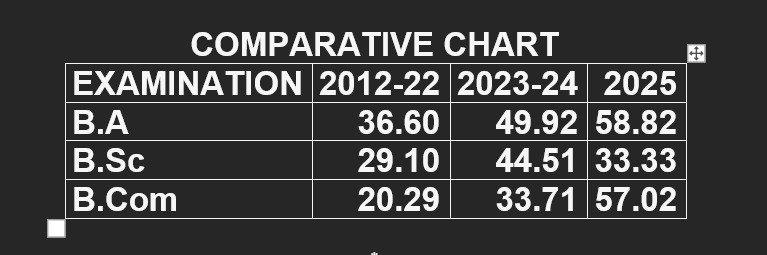
Notwithstanding the above, a noticeable improvement has been observed in examination outcomes based on currently available records:
Specifically, positive changes in B.A, B.Sc, and B.Com examination results indicate partial corrective measures. It is reasonable to conclude that these improvements were a direct consequence of the Open Charge Sheet.
Unresolved Questions and the Way Forward
Despite limited improvements, fundamental and serious questions remain unresolved. These questions will continue to confront the University of Karachi until systemic injustice is eliminated, institutional corruption is dismantled, and long-denied justice is delivered to affected students.
COMPARATIVE CHART
Questioning the Academic Logic of Examination Outcomes
Is commerce education so extraordinarily complex, difficult, and unforgiving that passing examinations has become akin to crossing a razor-sharp bridge, while education in medicine, law, education, science, and all diploma programs is allegedly so effortless that passing examinations has been reduced to a child’s game?
Or are commerce students so inherently incompetent, intellectually deficient, or incapable that success beyond 20% is impossible for them—while students of all other disciplines are presumed to be extraordinarily intelligent, capable, and gifted, with success supposedly falling effortlessly into their laps?
Statistical Evidence (2012–2022)
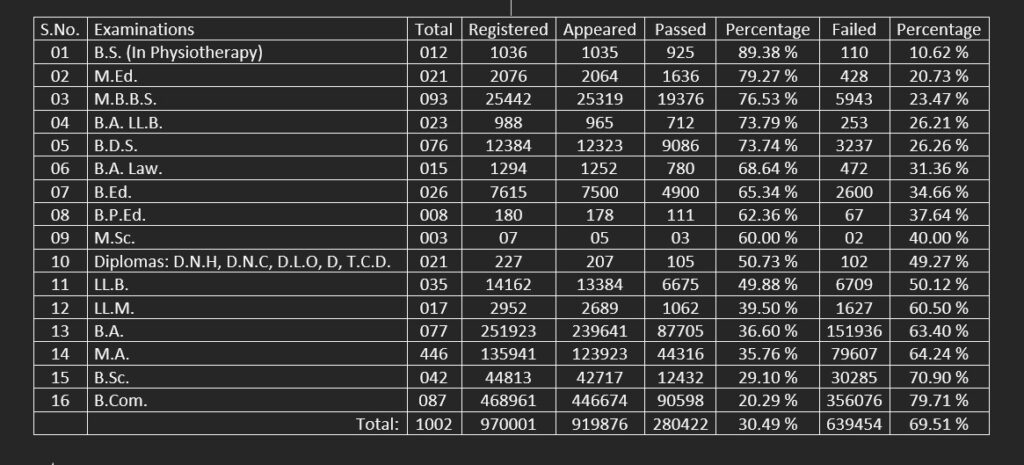
According to eleven years of examination data (2012–2022) available on the official website of the University of Karachi:
Do these figures not raise a serious question mark over the so-called performance of the University of Karachi, its affiliated institutions, and its so-called educators?
Just as:
In exactly the same manner, by deliberately distributing success within select favored disciplines while failing vast numbers of unfortunate students, the University of Karachi appears to have institutionalized a business model of pass and fail—a “pass–fail racket.”
For how long will grade gambling, score trading, position racketeering, and degree profiteering continue in Pakistan’s largest public university?
And finally—will the beginning of Pakistan’s educational revolution emerge from the University of Karachi itself?
Demands Raised in the Interest of Students
Ansar AbdulQahhar formally raised the following two demands in the interest of students:
Demand 1: Complete Disclosure of Examination Records
The eleven-year report titled “Open Charge Sheet” was prepared using examination results available on the University of Karachi’s website from 2006 to 2022. However, examination records from the establishment of the university to the present day, which remain unavailable, must be immediately disclosed without delay.
For the broader national and educational interest—and to rectify systemic failures—it is imperative that the University of Karachi provide complete examination records within thirty (30) days, from its inception to date, so that a comprehensive and conclusive report can be prepared and students may be liberated from the pass–fail racket.
Demand 2: Rectification, Apology, and Compensation
All students who appeared—either as regular or private candidates through affiliated colleges—in Arts, Science, and Commerce examinations under the University of Karachi, and who were deliberately failed under the university’s education-hostile policies, must have their cases reviewed and rectified within thirty (30) days upon request.
The University of Karachi must:
Note: The University of Karachi has not accepted either of these demands.
Failure to Challenge the Open Charge Sheet
The Open Charge Sheet explicitly stated that if the University of Karachi or any other authority disagreed with its findings, they could legally approach the relevant court within thirty (30) days of its publication. After this period, no claim would be admissible.
No such legal challenge was initiated.
The only response was the deletion of examination results (2006–2022) from the official University of Karachi website.
Note: The University of Karachi has not filed any legal case against Ansar AbdulQahhar in any court of law.
The Imperative of Comprehensive Accountability
In the broader national and educational interest, complete accountability of the University of Karachi—from its inception to date—has become unavoidable.
Who is responsible, and who is criminally liable, for:
An independent, data-driven, and non-partisan investigative report titled “Open Charge Sheet”, based on eleven years (2012–2022) of publicly available examination data—along with 2023–2025 results—will soon be published on a website.
Additionally, a separate 84-page analytical report, covering:
has already been compiled and stands independent of the Open Charge Sheet.
To determine accountability among University of Karachi officials, the corrective actions outlined in the Open Charge Sheet will be pursued with seriousness and resolve.
“According to the available eleven-year examination records (2012–2022),
The following facts have been established:”
Questioning the Academic Logic of Examination Outcomes
Is commerce education so extraordinarily complex, difficult, and unforgiving that passing examinations has become akin to crossing a razor-sharp bridge, while education in medicine, law, education, science, and all diploma programs is allegedly so effortless that passing examinations has been reduced to a child’s game?
Or are commerce students so inherently incompetent, intellectually deficient, or incapable that success beyond 20% is impossible for them—while students of all other disciplines are presumed to be extraordinarily intelligent, capable, and gifted, with success supposedly falling effortlessly into their laps?
Statistical Evidence (2012–2022)
According to eleven years of examination data (2012–2022) available on the official website of the University of Karachi:
Do these figures not raise a serious question mark over the so-called performance of the University of Karachi, its affiliated institutions, and its so-called educators?
Just as:
In exactly the same manner, by deliberately distributing success within select favored disciplines while failing vast numbers of unfortunate students, the University of Karachi appears to have institutionalized a business model of pass and fail—a “pass–fail racket.”
For how long will grade gambling, score trading, position racketeering, and degree profiteering continue in Pakistan’s largest public university?
And finally—will the beginning of Pakistan’s educational revolution emerge from the University of Karachi itself?
Demands Raised in the Interest of Students
Ansar AbdulQahhar formally raised the following two demands in the interest of students:
Demand 1: Complete Disclosure of Examination Records
The eleven-year report titled “Open Charge Sheet” was prepared using examination results available on the University of Karachi’s website from 2006 to 2022. However, examination records from the establishment of the university to the present day, which remain unavailable, must be immediately disclosed without delay.
For the broader national and educational interest—and to rectify systemic failures—it is imperative that the University of Karachi provide complete examination records within thirty (30) days, from its inception to date, so that a comprehensive and conclusive report can be prepared and students may be liberated from the pass–fail racket.
Demand 2: Rectification, Apology, and Compensation
All students who appeared—either as regular or private candidates through affiliated colleges—in Arts, Science, and Commerce examinations under the University of Karachi, and who were deliberately failed under the university’s education-hostile policies, must have their cases reviewed and rectified within thirty (30) days upon request.
The University of Karachi must:
Note: The University of Karachi has not accepted either of these demands.
Failure to Challenge the Open Charge Sheet
The Open Charge Sheet explicitly stated that if the University of Karachi or any other authority disagreed with its findings, they could legally approach the relevant court within thirty (30) days of its publication. After this period, no claim would be admissible.
No such legal challenge was initiated.
The only response was the deletion of examination results (2006–2022) from the official University of Karachi website.
Note: The University of Karachi has not filed any legal case against Ansar AbdulQahhar in any court of law.
The Imperative of Comprehensive Accountability
In the broader national and educational interest, complete accountability of the University of Karachi—from its inception to date—has become unavoidable.
Who is responsible, and who is criminally liable, for:
An independent, data-driven, and non-partisan investigative report titled “Open Charge Sheet”, based on eleven years (2012–2022) of publicly available examination data—along with 2023–2025 results—will soon be published on a website.
Additionally, a separate 84-page analytical report, covering:
has already been compiled and stands independent of the Open Charge Sheet.
To determine accountability among University of Karachi officials, the corrective actions outlined in the Open Charge Sheet will be pursued with seriousness and resolve.
“According to the available eleven-year examination records (2012–2022),
The following facts have been established:”
Statement C: The Examinations Results Summary Detai
As available on the Website of the University of Karachi
https://uok.edu.pk/ann_results/results.php
From January 2012 to December 2022
© United Krachistan Movement| All rights reserved.